TOP SECRET // EYES ONLY
File Ref: S2-BB/USAF — Subject: Project Blue Book (Codename: “CONDON”)
Classification: CLASS S2 – Skeptic / Agnostic Analysis
Date: 1969-12-17 [Declassified 1976; Recovered 2025]
CLASS S2 – PROJECT BLUE BOOK
Background Summary
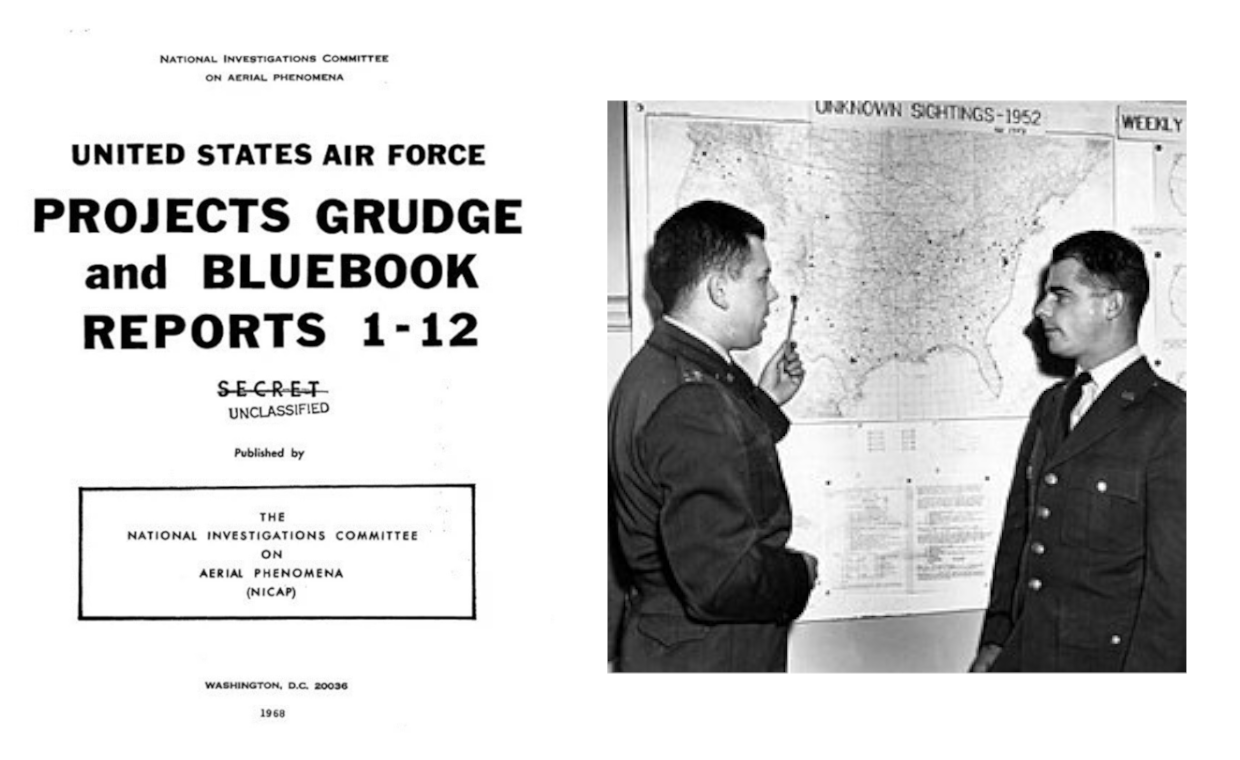
Project Blue Book was a U.S. Air Force program headquartered at Wright-Patterson Air Force Base, Ohio, which investigated unidentified flying objects (UFOs) between 1952 and 1969. The project’s objectives were twofold: determine if UFOs posed a threat to national security and analyze reports scientifically. In total, Blue Book collected 12,618 reports of UFO sightings. While most were explained as misidentified natural phenomena, conventional aircraft, balloons, satellites, or hoaxes, about 701 cases remained unexplained even after analysis. No evidence was found to indicate extraterrestrial origins or technology beyond the capabilities of modern science.
The program ended following the 1969 Condon Report, which concluded there was little scientific value in further UFO investigations. All records are now declassified and publicly available.
Key Figures
Captain Edward J. Ruppelt — First director; coined the term “Unidentified Flying Object” and led serious early investigations.
Dr. J. Allen Hynek — Astronomer and scientific consultant; began as a skeptic but later admitted some cases were unexplainable.
Major Hector Quintanilla — Final director; pursued a debunking approach, criticized for dismissiveness.
General Charles P. Cabell — Senior officer credited with initiating Blue Book in its earliest phase.
Findings & Statistics
12,618 reports investigated (1947–1969)
11,917 explained as natural or conventional phenomena.
701 remained unidentified.
Statistical Breakdown:
69% identified (38% conclusively, 31% doubtfully).
9% lacked sufficient information.
22% classified as unknown.
Conclusion: No UFO sighting indicated a national security threat or advanced technology of extraterrestrial origin. The report deemed it “highly improbable” that UFOs represented unknown developments.
Assessment
Project Blue Book represents the most comprehensive U.S. military investigation of UFOs to date. While its final conclusions support skepticism, its data archive preserves hundreds of unresolved cases that remain credible and debated among researchers. Blue Book therefore sits within Class S2 — official skepticism, but with a record of anomalies left unexplained.
The Condon Report
The Condon Report, completed in 1968 by the University of Colorado under Dr. Edward U. Condon’s direction, critically evaluated Project Blue Book’s findings and concluded that further UFO studies were unlikely to yield significant scientific discoveries, leading to the program’s termination and reinforcing skepticism about the extraterrestrial hypothesis.
The Condon Committee re-evaluated a selection of Project Blue Book cases, focusing on those considered particularly puzzling or unexplained, to determine if further scientific investigation was warranted. This included cases that remained unexplained after previous Air Force analysis, such as radar/visual sightings and reports with credible physical evidence. The review aimed to apply more rigorous scientific scrutiny and independent expert analysis. However, Condon’s team faced criticism for allegedly biased dismissal of positive findings and for framing the report to conclude that UFO research was unlikely to advance scientific knowledge, influencing the decision to end Project Blue Book.
Primary-source memos specifically explaining why Condon selected certain Blue Book cases are scarce in typical public online documents. However, Condon’s selection criteria generally focused on cases that were:
- Not fully explained by previous Air Force investigations,
- Featured good quality sightings (radar plus visual, multiple reliable witnesses),
- Had physical evidence or multiple sensor confirmations,
- Were considered scientifically puzzling or compelling for further study.
These memos or appendices are often found within the original Condon Report documents archived by government or university libraries, emphasizing rigorous scientific inquiry and exclusion of obviously flawed or hoax cases.
For deep primary documents, archival collections or official government repositories such as the National Archives or university special collections holding the original Condon Report and Air Force project documents would be the best sources.
Primary-source memoranda specifically identifying the dates and authors explaining why Condon selected particular cases are not widely available in common public online sources.
However, based on the original Condon Report (1968) and typical practice:
- The selection memos and related documents are generally authored by Dr. Edward U. Condon, the project director, and principal investigators from the University of Colorado UFO Project.
- They date from the project’s active years, primarily 1966 to 1968 during the formal study period.
- Selection memos aimed to focus scientific scrutiny on cases that were puzzling, poorly explained by prior studies, and had credible evidence for further investigation.
- Appendix A of the Condon Report includes case reviews which are likely prepared by research staff under Condon’s leadership.
For actual copies of such memoranda, the National Archives, university collections, or specialized government declassified document repositories that hold the original project files would be the primary resources to consult.
END // S2-001/USAF