Author Commentary:
There’s a scene in Alien I Am that I debated removing from the book more than any other scene.
It’s the scene where Emily and Amanda are sitting at the kitchen table after the first day of Integration.
Now, Integration in the book is where the marked young people have to help the aliens “sack” the rest of humanity into pods—people who are not going to make it. The unmarked. And marked is literal. It’s a physical mark on your arm that happens through abduction into an alien spaceship. So only a certain amount of young people are marked to live. And these young people have to assist the aliens in integrating the rest of the human race.
And if that sounds intense… it is.
This has been a long, hard day for Emily and Amanda. They are wiped out. In shock. Crushed. Devastated. And the thing that makes it unbearable is that they had to integrate their own parents.
I don’t know if anyone can really imagine going through that.
There’s a moment where Emily can’t do it. She can’t go through with integrating her own mother. And her best friend Amanda has to help her. And even Emily’s mother—who realizes the gravity of what’s happening—helps her own daughter put the sack around herself.
And Emily blacks out.
So now they finally get through that day and they make it home and they’re at the kitchen table. And Emily is drawing this symbol. She doesn’t fully know what it means yet, but it’s connected to what the aliens call Ser’ethra.
And let me say something about that word.
The word “love” that we use today carries so much baggage. It means so many different things that I don’t think it’s a very good descriptor anymore—at least not for what I’m trying to point at in this book. That’s why the aliens have their own word. Ser’ethra is a kind of love that is dangerous. It’s self-sacrificial. It’s the willingness to lay down your life for others.
So they’re sitting there at the kitchen table, and I’m writing this, and it’s affecting me emotionally. Because when you write stories, you’re not just moving chess pieces around. Stories are about real people and real events. Even though this is fiction—and yes, Alien I Am is in the fiction genre—these situations are still situations. These are things people go through. The emotions are real.
So when I first wrote this scene, Amanda pulls out a little pocket knife.
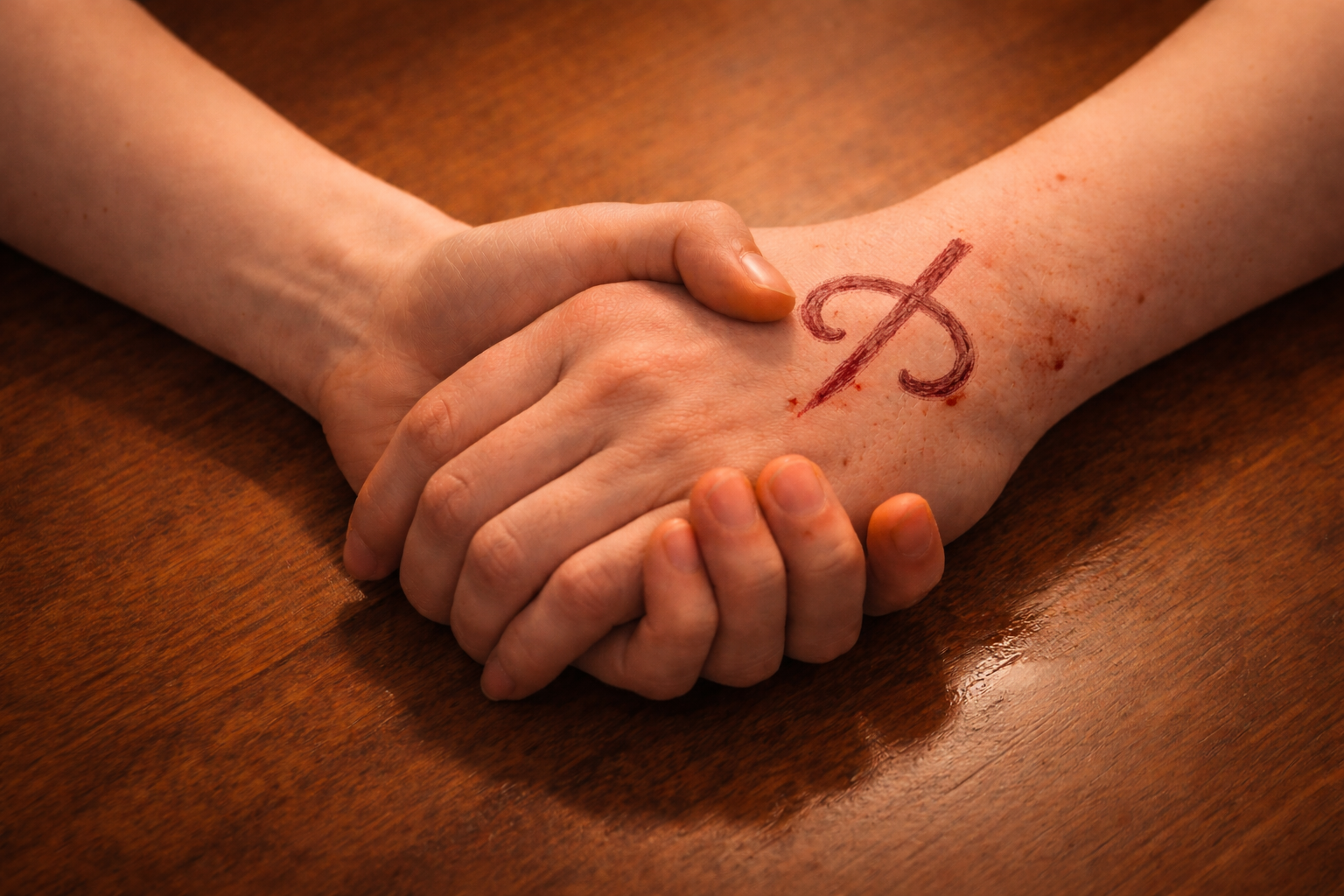
She has the pen knife in her right hand, and she starts carving the Ser’ethra symbol into the top of her left hand.
Emily wants to stop her. Emily is more grounded and conventional, let’s say. Amanda is more rebellious. Reckless. The type of person who will do something that scares you and you don’t even know how to react to it.
And Emily is about to stop her…
…but she doesn’t.
And the reason she doesn’t is important: Amanda is not marked.
Amanda went through the process of integrating their families, their friends, their teachers, the people in their town. She doesn’t even fully understand what the symbol means yet, but she understands that it’s deep. And here she is—unmarked—and she carves the symbol anyway.
Not deeply. Not dangerously. She’s not cutting into veins. She’s not trying to bleed out. She’s making a scratch, a mark, a vow.
And then Emily takes the knife and carves one on her hand too.
And they just sit there. Holding hands together. Looking at each other. With this deep, sick, warm, thick feeling in their stomachs. I don’t quite know how to explain it. I can just feel it.
And as I’m writing it, I’m thinking:
This just took my book out of the category for 11 and 12 and 13 year olds.
So I debated it.
I rewrote it with a magic marker. I rewrote it with ink pens. I rewrote it other ways. And it just didn’t carry the impact. It didn’t come out true in me.
And I know this act can be interpreted as self-harm. I get that. I’m aware of that. And I’m aware that many young people today cut on themselves. I really debated about whether I should put this in the book. Over and over again.
But here’s what I came to.
When I was a kid, we took pen knives and cut our fingers and made blood packs and swore on things running around in the woods. It wasn’t “self-harm” the way people mean it now. We weren’t thinking about hurting ourselves. We weren’t thinking about suicide. It wasn’t that.
It was about covenant. About bonding. About seriousness. About “I will not betray you.”
And this scene in the book is not about a desire to be hurt. It’s about two friends who just walked through one of the worst things they’ve ever had to walk through. And now this powerful galactic force is sending a symbol through consciousness—into their minds, into their hearts—and it’s doing something to them.
It’s a very, very powerful thing that’s happening here.
And there’s another layer too.
There’s something about blood that has been true throughout history. And I reference that in the book—Stonehenge and other things that point to this ancient idea: the shedding of our own blood for the sake of others. The idea that sacrifice is real, and it costs something, and you don’t get to pretend it doesn’t.
So yes—Amanda does it. Emily does it. Their hands end up with blood on them.
Not a lot. Not some horror scene. Just enough to make it undeniable: something has changed.
And I’ve even been told: take this scene out.
But I wanted to make something clear, to myself and to anyone who writes: there are some things you just can’t change. If you’re going to write your book and you’re going to be an author, you have to be true to yourself and true to your story. And this is one of those things that I felt had to stay.
So if you read that scene, I hope you take it the right way.
I hope you are not offended.
And I hope you don’t in any way feel the need to harm yourself, because that is not what this scene is about. This scene is about love—Ser’ethra—love that binds you to another person when the world is collapsing, when you’re terrified, when you’re numb, when you don’t know what’s next.
It’s two friends saying, without words:
“I’m still here. And I’m not leaving you.”
That’s why the scene stayed.
FREE CONTENT CHAPTER 29 FRAGMENT
Amanda and I sat at the kitchen table, silent, looking through my sketchbook. She stopped when she saw the glyph I’d scratched, her fingers hovering over the crooked lines. It was the first thing that made her speak.
“What’s this?” Amanda said.
“I don’t totally know,” I said, my throat tight. “But I think it has something to do with… what we’ve just been through.”
“It looks like a dagger. Or a sword.” ◇
Her voice was faint and shallow, but there was something new in it now—soft, almost careful. I could not begin to imagine what it had cost her to help so many people stay calm while they walked toward their deaths.
Before I could say anything else, she held out her hand for my pocketknife. My dad had given it to me for fishing, and I’d carried it ever since, tucked in the side pocket of my sketchbook satchel.
“Amanda—”
She pressed the tip to the top of her hand and dragged it across, tracing the glyph into her own skin like she was on autopilot, like the pain barely even registered. Blood welled up, drowning the symbol until it was just a smear of red. I wiped it clean with my sleeve, hands shaking, wanting to tell her to stop—but didn’t, knowing I couldn’t take this from her.
When she finished, she just stared at it. So did I. Time went thin and brittle around us.
Then I took the knife.
The metal was still warm from her palm as I carved the same mark into my own hand. The sting made my eyes water, but I didn’t look away.
When I was done, we laced our fingers together, blood sticking between us as our matching cuts dried.
We just looked at each other, caught in the strangest feeling—like being sick and warm at the same time. Like grief and peace trying to live in the same space.
For the first time, I felt full instead of hollow. I had fought for her. She was here with me. And for a heartbeat, in that tiny moment of pain and blood, it felt like the rest of the world—the ugly parts—couldn’t reach us.
We were fighting for each other now, in a world void of ugliness. ◆ DI#10
My own heart answered, raw and uneven, whispering a word in my mind I didn’t know the meaning of. I let it slip into Amanda’s thoughts, a shared pulse between us.
<Ser’ethra.>
The mark we cut into our hands.
Copyright © 2025 David Lawrence Markham
All rights reserved.
ISBN 13: 978-0-9907587-2-3