Author Commentary
When I first started writing Alien I Am, I wrote it from the perspective of the aliens.
That version mattered to me because it helped me frame the “big” questions—what they want, why they’re here, and what’s really happening behind the curtain of the human story. But it also had a limitation: it didn’t land in the heart the way I wanted it to. It was cosmic, conceptual, and strange in the right ways… but it wasn’t grounded in the part of life where most of us actually live.
And then, eleven years later, I made a decision that changed everything.
I rewrote the novel from the perspective of teenagers.
Why teenagers became the center
A couple years ago, I was given a research task that forced me to look closely at young people—what they’re dealing with, what they’re carrying, what kind of pressure they’re under. I didn’t expect it to hit me the way it did.
But I was shocked. Not in an abstract way. In a way that stays with you.
Young people are in crisis. And that truth never really left my heart.
So when I picked the novel back up—because I’ve been writing it for many years, on and off—I didn’t just want to “finish a book.” I wanted to write something for them. I wanted to write something to them. A story that doesn’t insult their intelligence, doesn’t pretend everything is fine, and still somehow manages to leave room for hope.
Because I think teenagers need something right now: a way to make sense of the avalanche of information, fear, and confusion. And yes—especially the growing cultural obsession with “disclosure” and the possibility of extraterrestrials.
The dossier idea: story on top, lore underneath
One of the core ideas I love most about Alien I Am is the dossier style.
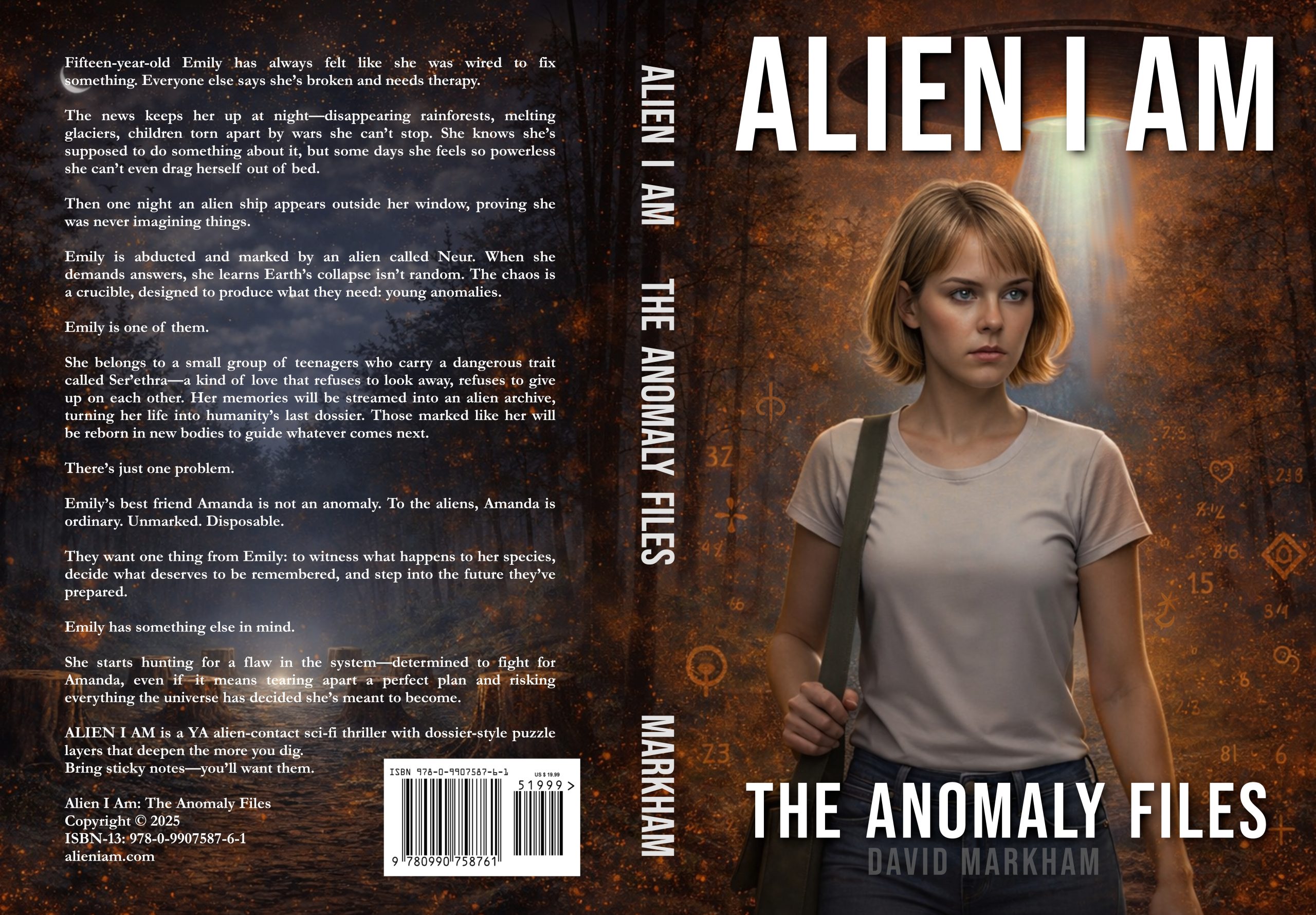
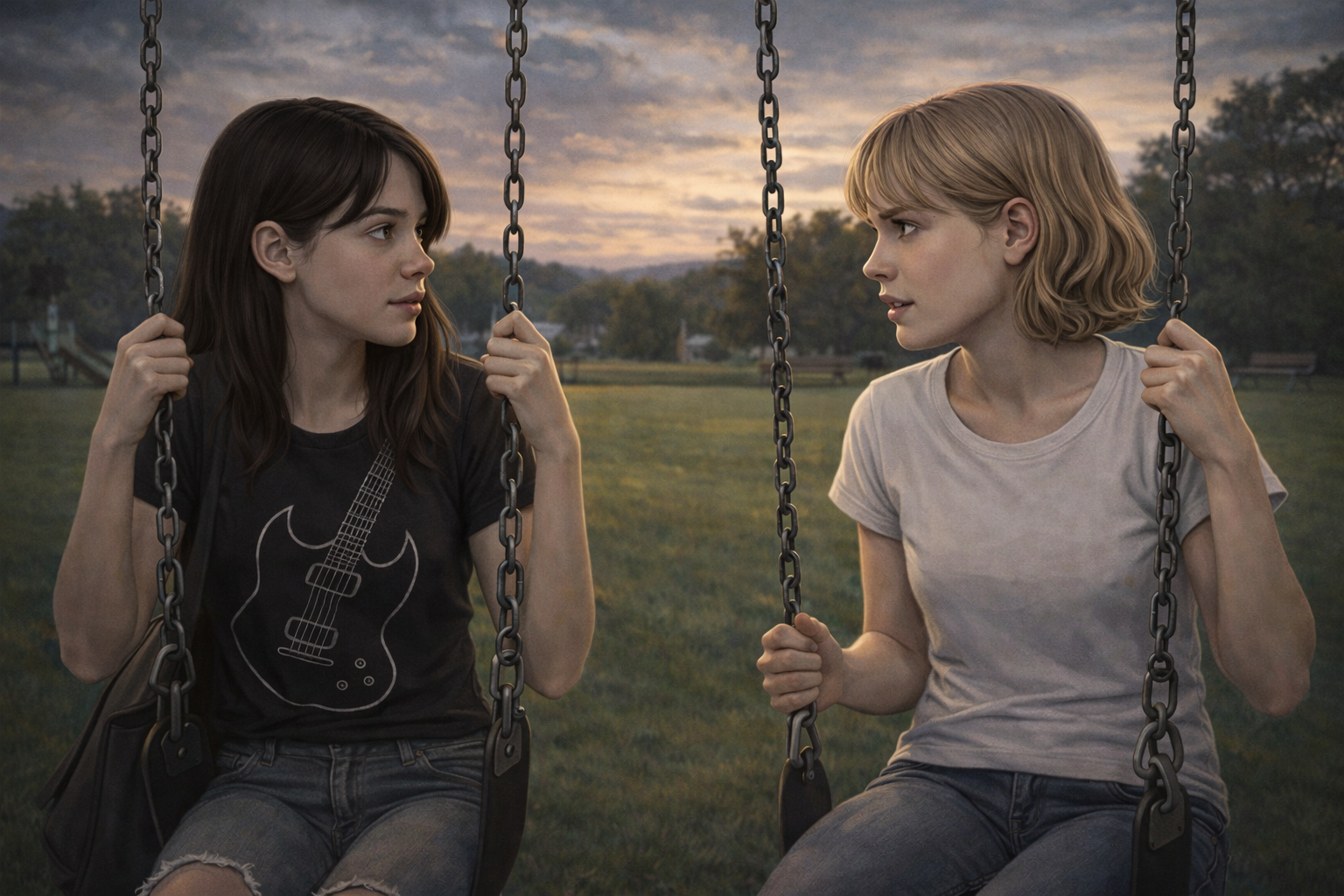
You can read it as a straight story—an intense, emotional, plot-driven novel about two teenagers, Emily and Amanda, and an alien named Neur. You can move through it, get swept up, and never stop to dig.
But if you want to go deeper, you can.
That part is optional by design.
The novel is built like an iceberg. The top layer is the human story: fear, friendship, grief, courage, and the dilemma of living through things you never asked for.
Underneath, there’s a whole hidden architecture: motives, history, instructions, traits, future plans, and an invasion that isn’t as simple as “aliens came to take over.” There are deeper layers—more races, more timelines, more context—waiting for the reader who wants to assemble the puzzle.
Making it accessible—even for 11, 12, 13-year-olds
I wanted this book to be accessible to very young readers—not because it’s “simple,” but because it’s inviting.
I’d love for 11-, 12-, and 13-year-olds to read it and get pulled into the lore the way I got pulled into lore-heavy stories when I was young. Because I spent many years developing the world behind Alien I Am, and most of that world doesn’t show up in long exposition paragraphs. It shows up through the layers.
There are little symbols in the writing—small chevrons you’ll encounter as you read. There are only two: a black diamond and a hollow diamond. They’re small, but they matter. They’re part of how the book signals: “There’s more here if you want it.”
The human dilemma is the point
Even though Alien I Am has aliens, abductions, and invasion elements… the story is really about the human dilemma.
What does it do to a person—especially a young person—to feel everything intensely in a world that feels like it’s unraveling?
How do you stay tender without breaking?
How do you hold onto hope without lying to yourself?
Emily and Amanda go through scenes that are meant to be deeply impacting—moments that hit emotionally, not just intellectually. And then, after those moments, the book gives you another option: you can breathe, step back, and explore the lore.
That rhythm matters to me. Emotion on the surface. Meaning underneath.
My take on “why they’re here”
One of the biggest reasons I had to write this book the way I wrote it is simple: the mainstream explanations for why aliens might be here have never been satisfying to me. They’ve never felt believable. They’ve never really made sense at a deep level.
So I did what writers do. I dug.
I’m not an expert, but I’ve done many hundreds—maybe thousands—of hours of research over the years. And yes, there’s a lot of confusion out there. A lot of noise. A lot of stories that don’t hold together.
But there are also patterns and ideas that do hold together—at least to me. And the ones that made the most sense are in the book. I had to add a few of my own.
Not always on the top level. Mostly below.
A puzzle you can live inside
At its heart, Alien I Am is a puzzle book.
It’s dossier-style files that you encounter and mentally arrange. It’s layers you can connect. It’s “reading the story” and also “reading between the story.”
And that’s exactly what Emily is doing inside the novel—with the help of her alien friend. Together they’re assembling a set of traits, characteristics, and instructions… like something meant to survive beyond the collapse, beyond the confusion, beyond the end of one world and the beginning of another.
What you’ll find in Alien I Am
On the surface, it’s sci-fi with teeth:
- abduction elements
- invasion elements
- dystopian / end-of-the-world pressure
- emotional survival and friendship
- and even a trip to another world
But beneath that, if you dig deep enough, you’ll find what I spent years building: the internal logic of the aliens, the “why,” the history, the races, the ships, the systems—and the parts of the story that only reveal themselves when you decide to go looking.
That’s the experience I wanted to make.
A great story you can simply enjoy…
and a deeper world you can enter, if you want more.
I hope you do.